
LazrTek Insights
A school district’s bus fleet is usually its largest capital asset outside the buildings themselves, and it is the only one that carries children on a public road twice a day with the district’s name on the side. Yet washing is often the least-planned part of transportation operations — handled with a pressure washer and whatever labor is available, on whatever schedule the weather permits.
When districts finally address it, the conversation stalls in a predictable place. Someone gets an equipment quote, presents it to the board, and the number lands without context. What does it replace? What does it prevent? Where does the money come from? Why this configuration and not a cheaper one?
We work with districts on exactly this question, and this is the framework that gets a bus wash approved and correctly specified.
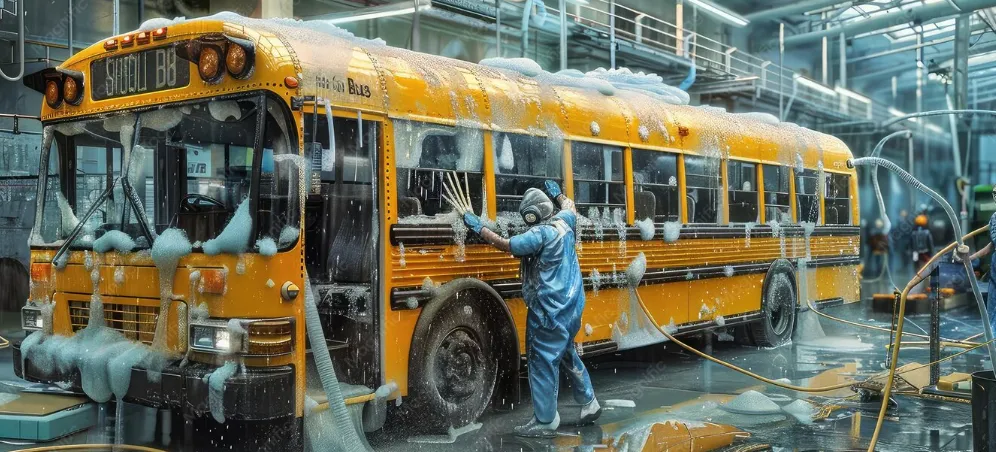
A school bus in an automated gantry wash at a district depot at dawn with the fleet lined up behind
The Real Constraint Is the Morning Window
Start with operations, not price. A school bus fleet has a scheduling profile unlike almost any other fleet.
A school bus exiting an automated wash bay with an attendant monitoring the cycle.
Buses leave in a compressed morning block, return, sit through the middle of the day, leave again in the afternoon, and come back. Washing has to happen inside a window that does not conflict with routes, does not conflict with driver hours, and does not require staff on shift at hours the district is not already paying for.
That constraint drives the throughput requirement, and the throughput requirement drives the equipment format. So do this arithmetic before looking at any quote:
How many buses in the fleet?
How often should each be washed? Weekly is a common target; districts in heavy-salt or heavy-dust regions often want more in season.
How many washing hours per day are actually available, given routes, staffing, and daylight?
Divide. That gives you required buses per hour.
A district running 100 buses on a weekly cycle needs to move 20 buses a day across a five-day week. If the available window is three hours, that is roughly seven buses per hour — meaning about eight minutes per unit including staging, not just machine time.
Now the equipment conversation has a specification instead of a preference.
Gantry or rollover systems — where the bus parks and the arch travels over it — generally complete a cycle in the three-to-five-minute range. They have a smaller footprint, lower capital cost, and work well for fleets where the window is adequate and the site is tight. For many mid-sized districts, this is the right answer.
Drive-through systems move the bus continuously past fixed arches, which is faster per unit and better suited to large fleets or narrow windows. They cost more and need more site length, including approach and exit room for a full-size bus.
The mistake we see most often is a district buying on capital cost alone, installing a system that cannot clear the fleet inside the available window, and quietly reverting to washing half the fleet half as often. The equipment works. The specification did not match the operation.
Staging matters as much as cycle time. A bay that can wash a bus in four minutes but has room for only one bus to wait will not hit its theoretical throughput, because the arch sits idle between units. Approach lanes, stacking space, and a clear exit path are part of the throughput calculation, not site cosmetics.
What the Project Actually Costs
Districts consistently underestimate total project cost, because the quote they receive is for equipment and the project is not.
Equipment. A single-bay automated bus wash system typically falls in the low-to-mid six figures, with gantry configurations at the lower end and drive-through systems above them. Options — undercarriage, wheel wash, additional chemistry stages, freeze protection — move the number.
Structure. A bay building or canopy. In cold climates this is not optional, because an unenclosed system in freezing conditions is a system you cannot run for part of the year in exactly the season when salt removal matters most.
Site and civil. Concrete pad engineered for bus weight and drainage, approach and exit paving, trench drains, and grading.
Utilities. Water service adequate for the system’s flow rate, electrical service, and in most cases a gas or electric heat source.
Water treatment. An oil-water separator is effectively always required. Reclaim may be required or strongly advisable depending on the jurisdiction and water cost. Both are capital items with ongoing maintenance.
Permitting and design. Engineering, plan review, and the industrial discharge permit process, which for a district facility often runs in parallel with other approvals and takes longer than expected.
A realistic total installed cost is commonly a meaningful multiple of the bare equipment number. That is not a reason to abandon the project — it is a reason to budget it once, correctly, rather than returning to the board twice.
How Districts Actually Fund It
Public procurement is its own discipline, and the funding path often determines whether the project happens at all.
Capital outlay. The straightforward route where a district has capital funds available and the amount fits within existing authority. Simple, but competes directly against buses, roofs, and buildings in the same budget cycle.
Bond funding. Where a wash facility is included in a larger transportation or facilities bond package, it typically rides along without needing to win a standalone argument. This requires planning ahead of the bond cycle, which is the single most common missed opportunity we see.
Municipal lease-purchase. A structure designed for public entities that spreads acquisition cost across multiple fiscal years while the district takes ownership at the end. It converts a difficult capital ask into a predictable annual operating line, and it is frequently the practical answer for districts whose capital budgets are fully committed. Non-appropriation language is standard and protects the district if funding is not approved in a future year.
Cooperative purchasing contracts. Purchasing cooperatives allow districts to buy from contracts that have already been competitively bid, satisfying procurement requirements without running a full solicitation. This can compress timelines significantly.
We work with districts through all four paths and can structure municipal arrangements directly. The important step is deciding the funding route early, because it shapes documentation, timeline, and how the specification is written.
Undercarriage and Winter Corrosion
For districts in any region that treats roads with salt or brine, undercarriage washing is where the financial case is strongest — and it is the capability most often cut to save capital cost.
Undercarriage wash spray removing road salt from a school bus chassis and suspension components.
Road salt and liquid deicers accumulate on frame rails, crossmembers, brake and air lines, wiring harnesses, fuel and exhaust components, and body seams. Left in place, they corrode. That corrosion shows up as brake line failures, air line leaks, electrical faults, structural rust, and inspection findings. It shortens the service life of a vehicle the district expects to keep for well over a decade, and it reduces what that vehicle is worth when it is finally sold.
Exterior washing addresses appearance and visibility. Undercarriage washing addresses the part of the vehicle that determines whether it passes inspection in year twelve.
The chemistry matters too. Salt neutralizers and corrosion inhibitors are formulated specifically to remove chloride residue rather than simply rinse the surface, and they behave differently from general-purpose detergents. A district that installs an undercarriage system but runs generic chemistry through it captures only part of the benefit. This is also where pH matters for a mixed fleet — aggressive brighteners suited to aluminum trailers are not appropriate for painted bus bodies and their fasteners.
The Case You Make to the Board
Boards approve projects that solve a stated problem. A bus wash quote by itself is a number; framed properly, it is four arguments.
Safety and visibility. Clean windows, mirrors, lights, reflectors, and stop-arms are directly related to whether a bus is seen and whether a driver can see. This is the argument that carries the most weight in a public meeting, and it is legitimate.
Labor. Hand washing a bus properly takes roughly thirty to forty-five minutes of labor. Across a hundred-bus fleet on a weekly cycle, that is a large recurring cost being spent on a task automation performs faster and more consistently — and it is labor that could be redirected to maintenance work the district is otherwise deferring or outsourcing.
Asset life. Corrosion control extends the service life of a fleet the district intends to hold for a long time. Every additional year of service from a bus is a capital replacement deferred.
Water and compliance. A properly designed automated system with reclaim uses dramatically less fresh water than hose-and-pressure-washer washing, and it captures and treats the wastewater rather than letting it run to a storm drain. That last point matters: uncontained washing on an open lot is a stormwater compliance exposure many districts do not realize they are carrying.
Present these together with the throughput math, and the request stops being an equipment purchase and becomes an operations plan with a price attached.
Specifying It Correctly
A few points that make the difference between a system that serves the district for fifteen years and one that becomes a maintenance headache:
Size for the fleet you will have. If the district is growing or considering consolidation of another depot, specify for that, not for today’s count.
Plan for freeze protection. In cold climates, this is core infrastructure, not an accessory.
Confirm parts and service availability locally. A district cannot afford a system that waits three weeks for a part. Ask specifically about local service response and parts stocking.
Write the maintenance schedule into the plan. Nozzles, sensors, pumps, filters, and the separator all need scheduled attention. Assign it to a named role before the system is installed, or it will not happen.
Train more than one person. Staff turnover is normal. A system that only one retiring employee knows how to operate is a system that stops being used.
Include the separator maintenance and permit reporting. These are ongoing obligations with real deadlines, and they belong in the operations plan alongside the wash schedule.
Frequently Asked Questions
How much does a school bus wash system cost?
Equipment for a single-bay automated system typically runs in the low-to-mid six figures depending on configuration, with gantry systems below drive-through systems. Total installed cost adds the bay or canopy, concrete and site work, utilities, water treatment, separator, and permitting — commonly a substantial multiple of the equipment number alone.
How long does it take to wash a bus automatically?
A gantry or rollover system generally runs a three-to-five-minute cycle; a drive-through is faster per unit because the bus keeps moving. Real throughput depends on staging and queueing as much as cycle time, so plan for roughly eight minutes per unit end to end when sizing against your window.
How do districts pay for it?
Capital outlay, bond funding, municipal lease-purchase spread across fiscal years, or a cooperative purchasing contract that satisfies competitive bid requirements. Lease-purchase is often the most workable route when capital budgets are committed.
Is automation cheaper than hand washing?
Usually, once labor is counted honestly. At thirty to forty-five minutes of labor per bus, a hundred-bus weekly cycle accumulates significant recurring cost. The larger gains are often indirect — consistency, water reduction, and extended vehicle life.
Does washing reduce maintenance cost?
Regular washing — especially undercarriage washing where road salt is used — reduces corrosion on frame rails, brake and air lines, and wiring, which drives repair cost, downtime, inspection outcomes, and resale value.
LazrTek has installed wash systems for districts including Vicksburg Warren and Catawba County Schools. We can size a system against your fleet count and morning window, price the complete project rather than just the equipment, and structure municipal financing that fits your fiscal calendar.