
Since the Fourth Interstate Treaty on Gambling (GlüStV 2021) came into force on 1 July 2021, Germany has operated one of Europe’s most tightly regulated online gambling markets. Sports betting, virtual slots, and online poker are now legal under a nationwide licensing system supervised by the Joint Gambling Authority of the Federal States (GGL). For players trying to understand which operators are licensed and how the rules work, guides such as DeutscherSpieler have become a useful starting point for navigating this complex landscape.
But behind every legal wager sits a tax bill. Germany taxes gambling heavily, and the money it collects flows into public budgets that fund everything from grassroots sport to addiction prevention. Below is a clear breakdown of how much the German state earns from gambling and where those billions actually go.
How Gambling Is Taxed in Germany
Germany’s approach is unusual by international standards. Instead of taxing operators on their profit (gross gaming revenue), the country taxes the amount players stake. Under the Race Betting and Lottery Act, a rate of 5.3% is applied to the net stakes placed on sports betting, virtual slot machines, online poker, and horse-race betting.
This “turnover tax” means an operator pays tax on every euro wagered, regardless of whether the player wins or loses. Lotteries, meanwhile, are taxed separately and remain by far the largest single contributor to gambling tax revenue in Germany.
Turnover Tax vs. GGR: A Contested Model
Industry representatives have argued for years that taxing stakes rather than profit makes the licensed market uncompetitive, particularly for high-volume slot players. Critics say the model pushes serious gamblers toward unlicensed offshore sites, while the GGL maintains that illegal gambling accounts for only a small fraction of total activity. This disagreement over the true size of the black market is one of the most debated issues in German gambling policy.
How Much Does the State Collect?
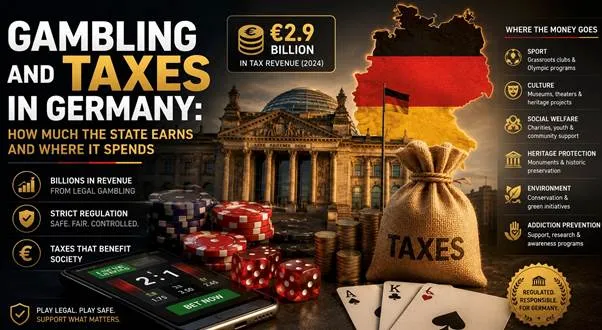
Germany’s licensed gambling market generated roughly €14.4 billion in gross gaming revenue in 2024, a 5% increase on the previous year. From this activity, gambling-specific tax revenue reached approximately €2.9 billion, with lotteries accounting for the largest share.
The rough distribution of tax income across the main verticals looks like this:
|
Gambling type |
Tax basis |
Contribution to tax revenue |
|
Lotteries |
Separate lottery taxation |
Largest single share |
|
Virtual slots |
5.3% of stakes |
Growing but declining recently |
|
Sports betting |
5.3% of stakes |
Significant, relatively stable |
|
Online poker |
5.3% of stakes |
Smaller share |
|
Horse-race betting |
5.3% of stakes |
Marginal |
Where Does the Money Go?
Gambling tax revenue in Germany does not flow into a single federal pot. Instead, most of it is distributed to the 16 federal states (Länder), which historically earmark large portions of lottery and gambling proceeds for public-benefit purposes. These “good-cause” allocations are a defining feature of the German system.
Typical destinations for this funding include:
● Sport – grassroots clubs, regional sports associations, and Olympic training programmes.
● Culture and the arts – museums, theatres, festivals, and cultural heritage projects.
● Social welfare – charities, youth work, and community organisations.
● Monument and heritage protection – restoration of historic buildings and landmarks.
● Environmental projects – conservation and nature protection initiatives.
● Addiction prevention and research – gambling-harm services, the OASIS self-exclusion system, and public awareness campaigns.
In other words, a slice of every legal bet ultimately supports public services that most citizens benefit from, whether or not they ever gamble themselves.
Why It Matters for Players
For German players, the tax system has two practical consequences. First, the high turnover tax influences the odds, bonuses, and payout structures that licensed operators can realistically offer. Second, choosing a licensed platform ensures that the money contributes to regulated, tax-paying activity rather than the unregulated offshore market.
Germany’s gambling tax framework reflects a deliberate balancing act: generating billions in public revenue while trying to keep gambling harm in check. Whether the current turnover-based model survives future reform remains one of the most closely watched questions in the European gambling industry.
Frequently Asked Questions (FAQ)
How much tax do you pay on gambling in Germany?
Players themselves do not usually pay tax on their winnings from licensed gambling in Germany. The tax is levied on operators: a rate of 5.3% is applied to the net stakes placed on sports betting, virtual slots, online poker, and horse-race betting. Lotteries are taxed under a separate system.
Are gambling winnings taxable in Germany?
For recreational players, winnings from licensed gambling are generally not treated as taxable income, because the tax is already collected at the operator level through the turnover tax. Professional gambling can be treated differently, so anyone who gambles as a business activity should seek individual tax advice.
How much money does the German state earn from gambling?
In 2024, Germany collected roughly €2.9 billion in gambling taxes. This came from a licensed market that generated about €14.4 billion in gross gaming revenue, with lotteries contributing the largest single share of tax income.
Why does Germany tax stakes instead of profit?
Germany applies a turnover tax, meaning operators pay tax on every euro wagered rather than on their profit. Lawmakers chose this model partly for simplicity and predictability, but the industry argues it makes the licensed market less competitive and pushes some players toward unregulated offshore sites.
Where does gambling tax revenue go in Germany?
Most gambling tax revenue is distributed to the 16 federal states (Länder), which traditionally earmark large portions for public-benefit purposes. Typical destinations include sport, culture, social welfare, monument protection, environmental projects, and gambling-addiction prevention and research.
Is online gambling legal in Germany?
Yes. Since the Fourth Interstate Treaty on Gambling (GlüStV 2021) came into force on 1 July 2021, online sports betting, virtual slots, and online poker have been legal under a nationwide licensing system supervised by the Joint Gambling Authority of the Federal States (GGL).
Who regulates gambling in Germany?
The central authority is the Gemeinsame Glücksspielbehörde der Länder (GGL), fully operational since 2023. It issues nationwide licences, supervises operators, and enforces the rules against unlicensed gambling and illegal advertising.
How can I tell if a gambling site is licensed in Germany?
Licensed operators appear on the official GGL whitelist and must meet strict requirements, including player-protection measures, a security deposit, and connection to the OASIS self-exclusion system. Checking the licence status before playing helps ensure your activity stays within the regulated, tax-paying market.