
By late July, Canadian growers are working ground between crops: pulling spent peas, opening a strip for fall garlic, folding a green manure into a market bed. The difficulty of that work has less to do with horsepower than with a detail most buyers never consider, which is why a self-propelled tiller feels so different in the hands from a machine of identical engine rating.
The reason is the most counterintuitive fact about tilling machines: a rotating tine set does not only cut soil. It pushes itself.
A tine in the ground behaves like a driven wheel
Picture a bicycle wheel gripping pavement. The tire pushes backward against the ground, and the ground pushes the bicycle forward. Every driven wheel works that way, trading a rearward shove against the earth for forward motion.
Tines do the same, because they contact the ground while turning. Whatever direction they sweep the soil, the soil pushes back the other way, and that reaction travels up the handles into the arms of the operator.
Forward rotation drives the machine away from the cut
Tines turning the same direction as the wheels roll are called forward-rotating. They sweep soil rearward beneath the machine, so the reaction shoves the unit forward, exactly as a driven wheel would.
In loose, previously worked soil this is convenient. In firm ground it is not: the tines cannot penetrate fast enough to stay engaged, so they skip along the surface, the machine scoots ahead, and depth stays disappointingly shallow.
Fighting that behavior is what wears people out. The operator leans back and drags on the handles all afternoon just to keep the tool over unfinished ground. Back and shoulder fatigue after a day of tilling is rarely about weight; it is about resisting thrust.
Counter-rotation converts thrust into digging force
Counter-rotating tines turn the opposite way, sweeping soil forward and upward beneath the machine. The reaction is therefore rearward, opposing forward travel instead of encouraging it.
That single reversal changes the work. With the tines resisting their own advance, a self-propelled tiller holds position, and holding position is what buys depth. Tines that stay over one spot have time to cut down through sod or packed clay rather than skating across it.
•Forward rotation: fast surface stirring, shallow bite
•Forward rotation: machine pulls ahead, operator resists
•Counter-rotation: rearward thrust, machine stays put
•Counter-rotation: deeper cut, better for sod
Independent drive wheels separate cutting from walking
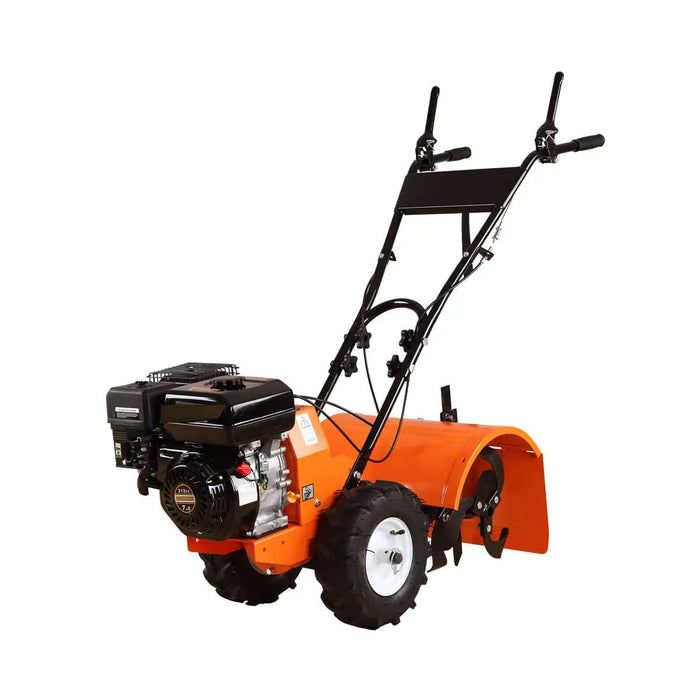
Counter-rotation creates an obvious problem. If the tines push backward, nothing moves the machine along the row. Something else must supply forward travel, and that is what self-propulsion provides.
On a self-propelled tiller, the transmission drives the wheels through their own gearing, independent of the tine shaft. The two functions come apart cleanly: wheels handle travel at a controlled speed, tines handle cutting at whatever depth the soil allows.
The practical gain is control rather than raw power. Ground speed no longer depends on how well the tines happen to be gripping, so heavy clay can be worked slowly and deeply while a finished bed is passed over quickly.
A bidirectional self-propelled tiller simply lets an operator pick the mode that suits the ground underfoot. Counter-rotation opens compacted headland or old pasture; forward rotation blends compost into a loose bed without tearing it up.
Understood this way, tine direction is not a specification detail but the whole ergonomic argument. Because the reaction from a rotating tine set either fights the operator or works for the operator, a bidirectional self-propelled tiller lets a Canadian grower choose which, and finish a summer bed without wrestling the handles.